




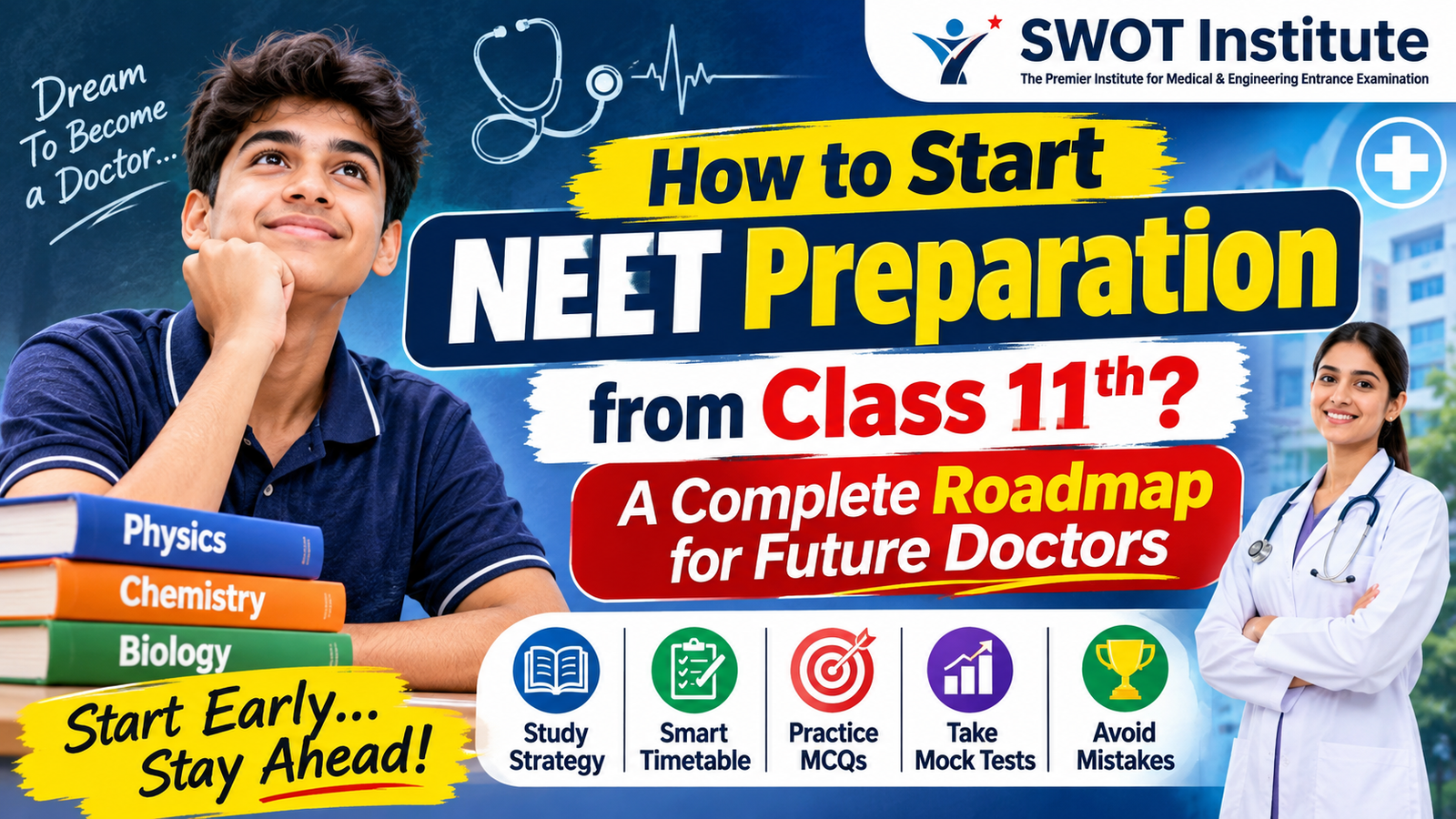
Complete Roadmap for Future Doctors
Published by SWOT Institute | The Premier Institute for Medical & Engineering Entrance Examination
Becoming a doctor is a dream for thousands of students across India. For many, this dream begins much before they enter a medical college. It starts with a simple decision in Class 11th — choosing the right subjects, developing strong concepts and preparing with the right direction.
The National Eligibility cum Entrance Test (NEET-UG) is one of India’s most important medical entrance examinations. Every year, lakhs of students appear for this examination with the hope of securing admission to medical courses.
But here is an important question:
How should a student start NEET preparation from Class 11th to build a strong foundation and stay ahead of the competition?
The answer is simple: Start early, understand concepts deeply, follow a structured study plan and remain consistent.
At SWOT Institute – The Premier Institute for Medical & Engineering Entrance Examination, we believe that successful preparation is not about studying for endless hours. It is about studying smartly, understanding every concept and practising regularly.
1. Understand the NEET Examination Before You Start
Before beginning preparation, students should understand the examination pattern and syllabus.
NEET-UG primarily tests students in three subjects:
- Physics
- Chemistry
- Biology (Botany and Zoology)
Biology carries the highest weightage, accounting for 360 marks out of 720. Physics and Chemistry carry 180 marks each.
This makes Biology particularly important, but students should never ignore Physics and Chemistry.
The examination tests more than memorisation. It evaluates conceptual understanding, application of knowledge, accuracy and time management.
The first rule of NEET preparation: Understand the examination before planning your preparation.
2. Build Strong NCERT Concepts from Day One
One of the biggest mistakes students make is collecting too many reference books and study materials.
For NEET preparation, NCERT textbooks should form the foundation of your learning, especially for Biology and Chemistry.
For Biology:
- Read every NCERT chapter carefully.
- Understand diagrams, tables and important examples.
- Highlight important definitions and scientific terms.
- Revise each chapter regularly.
- Practise MCQs after completing the chapter.
For Chemistry:
- Develop a clear understanding of basic concepts.
- Practise numerical problems in Physical Chemistry.
- Learn reactions and mechanisms in Organic Chemistry.
- Revise facts, trends and concepts in Inorganic Chemistry.
- Read the relevant NCERT content thoroughly.
For Physics:
- Understand the meaning behind every formula.
- Develop mathematical and numerical-solving skills.
- Practise questions of different difficulty levels.
- Focus on conceptual clarity rather than memorising solutions.
Remember, a strong understanding of Class 11th concepts will also make Class 12th preparation easier.
3. Follow a Proper Study Timetable
A disciplined timetable is one of the most powerful tools for a NEET aspirant.
Students should balance school education, coaching classes, self-study, revision and adequate rest.
These are suggested study hours outside regular school and coaching classes, not a compulsory target for every student. Quality and consistency matter more than simply counting hours.
Our advice: Start with a manageable routine and gradually increase your study capacity.
4. Give Special Attention to Class 11th Physics
Physics is often considered one of the most challenging subjects in NEET preparation.
Many students struggle because they try to memorise formulas without understanding the concepts behind them.
Start by developing a strong understanding of:
- Units and Measurements
- Motion in a Straight Line
- Motion in a Plane
- Laws of Motion
- Work, Energy and Power
- System of Particles and Rotational Motion
- Gravitation
- Properties of Matter
- Thermodynamics
- Oscillations and Waves
Do not rush through these chapters.
Understand the theory, solve basic questions, practise numerical problems and gradually move towards NEET-level MCQs.
Remember: Physics becomes easier when you understand the logic behind the formula.
5. Master Biology Through NCERT
Biology is a crucial subject for every NEET aspirant.
Students should develop the habit of reading NCERT Biology regularly instead of depending entirely on coaching notes.
Important Class 11th areas include:
- The Living World
- Biological Classification
- Plant Kingdom
- Animal Kingdom
- Morphology of Flowering Plants
- Anatomy of Flowering Plants
- Cell: The Unit of Life
- Biomolecules
- Cell Cycle and Cell Division
- Plant Physiology
- Human Physiology
A useful technique is to read a topic, close the book and explain the concept in your own words.
This improves understanding and helps identify gaps in learning.
Also practise diagram-based questions and assertion-reason questions wherever relevant to the examination pattern.
6. Develop a Smart Chemistry Preparation Strategy
Chemistry requires a balanced approach because its three major branches demand different learning methods.
Physical Chemistry: Focus on formulas, concepts, calculations and numerical practice.
Organic Chemistry: Understand basic principles, reaction mechanisms and the relationship between different reactions.
Inorganic Chemistry: Develop familiarity with NCERT facts, periodic trends, chemical properties and important reactions.
Students should revise Chemistry frequently because concepts and reactions become easier to retain through regular practice.
7. Practise MCQs Every Day
Reading theory alone is not sufficient for NEET.
Students must develop the ability to apply what they learn.
After completing every topic:
- Solve basic conceptual questions.
- Practise NEET-level MCQs.
- Analyse incorrect answers.
- Identify weak concepts.
- Revise and attempt similar questions again.
Maintain a separate notebook for mistakes.
This notebook can become one of your most valuable revision tools before the examination.
A student who learns from mistakes improves faster than a student who simply keeps solving more questions.
8. Take Regular Tests and Analyse Your Performance
Testing is not just about checking marks. It is about understanding your preparation level.
Students should follow a gradual testing system:
- Chapter-wise tests after completing topics.
- Weekly tests to assess learning.
- Monthly cumulative tests.
- Full-length mock tests as syllabus coverage progresses.
After every test, analyse:
- Which questions were answered incorrectly?
- Which topics consumed too much time?
- Were mistakes due to weak concepts or careless calculation?
- Which chapters require additional revision?
Do not become discouraged by low marks in initial tests.
Use every test as an opportunity to improve.
9. Avoid These Common NEET Preparation Mistakes
Many students work hard but fail to achieve their desired results because of avoidable mistakes.
Here are some common mistakes to watch out for:
1. Ignoring NCERT: Depending entirely on notes and reference books can create gaps in preparation.
2. Studying without a timetable: An unstructured routine often leads to incomplete syllabus coverage.
3. Avoiding Physics: Leaving difficult topics for later creates unnecessary pressure.
4. Collecting too many books: Multiple resources can create confusion. Focus on quality study material.
5. Skipping revision: Concepts that are not revised regularly become difficult to recall.
6. Ignoring mock test analysis: Attempting tests without learning from mistakes reduces their value.
7. Comparing yourself with others: Every student has a different learning speed. Focus on your own progress.
10. The Importance of Choosing the Right NEET Coaching Institute
A student’s hard work is essential, but the right academic guidance can make the preparation journey more organised and effective.
A good NEET coaching institute should provide:
- Experienced and dedicated faculty.
- Concept-based teaching methodology.
- Structured syllabus coverage.
- Regular tests and performance analysis.
- Personal attention to students.
- Doubt-clearing sessions.
- A disciplined academic environment.
- Proper guidance for school and competitive examination preparation.
Parents should evaluate the quality of teaching, faculty interaction, test system and academic support before selecting an institute.
At SWOT Institute, our focus is to develop strong academic foundations, encourage scientific thinking and prepare students to face competitive examinations with confidence.
11. Why Starting NEET Preparation in Class 11th Gives You an Advantage
Class 11th is the right time to develop a serious and organised approach towards NEET preparation.
Students who start early get sufficient time to understand concepts, practise questions and improve their weak areas.
Some important advantages include:
- Two-year preparation window: Sufficient time to cover both Class 11th and 12th syllabus.
- Strong conceptual foundation: Better understanding of Physics, Chemistry and Biology.
- Regular revision: More opportunities to revise important topics.
- Better test performance: Time to identify and improve weak areas.
- Reduced last-minute pressure: A planned approach makes preparation more manageable.
- School and NEET balance: Students can prepare for board examinations and competitive examinations together.
The biggest advantage is that students can develop good study habits before the actual examination pressure begins.
12. Your Two-Year NEET Preparation Roadmap
Here is a suggested preparation strategy for students beginning in Class 11th.
Year 1 – Class 11th
Build the foundation
- Understand fundamental concepts in all three subjects.
- Complete the prescribed Class 11th syllabus systematically.
- Develop daily MCQ-solving habits.
- Revise NCERT regularly.
- Take chapter-wise and cumulative tests.
- Identify weak areas and work on them.
- Year 2 – Class 12th
- Strengthen and perform
- Complete Class 12th syllabus on schedule.
- Continue revising Class 11th topics.
- Practise mixed-subject MCQs.
- Attempt full-length mock examinations.
- Improve speed, accuracy and time management.
- Analyse performance and revise weaker chapters.
- Prepare systematically for the final examination.
The exact syllabus and examination pattern should always be checked against the latest official NTA notification. For reference, the NEET-UG 2026 examination scheme specified 180 compulsory questions for 720 marks, with 180 minutes of examination time. S3WaaS +1
13. How SWOT Institute Can Help You Prepare for NEET
Choosing the right academic environment can make a meaningful difference in a student’s preparation journey.
At SWOT Institute – The Premier Institute for Medical & Engineering Entrance Examination, our objective is to help students build strong academic foundations and develop the skills required to succeed in competitive examinations.
Our academic approach focuses on:
- Concept-oriented teaching in Physics, Chemistry and Biology.
- Structured preparation for NEET and other competitive examinations.
- Strong foundation development for school students.
- Regular practice and assessment.
- Individual academic guidance and doubt resolution.
- Development of discipline, confidence and independent learning.
We believe every student has potential. With the right guidance, consistent effort and a supportive academic environment, that potential can be developed into meaningful achievement.
Our vision is not just to prepare students for an examination, but to prepare them for the opportunities and challenges of their future.
Final Words: Start Today, Build Your Future
Your dream of becoming a doctor deserves more than temporary motivation. It requires commitment, discipline, patience and a clear academic roadmap.
Class 11th is an excellent opportunity to begin this journey.
Do not wait for the perfect time. Do not be afraid of difficult subjects. Do not compare your progress with others.
Start with one chapter, understand one concept and solve a few questions every day.
Small efforts, repeated consistently, create remarkable results.
Your journey towards becoming a doctor begins with the decisions you make today.
Join SWOT Institute
The Premier Institute for Medical & Engineering Entrance Examination
Q1. Is Class 11th the right time to start NEET preparation?
Yes. Class 11th provides a valuable two-year preparation window to develop strong concepts, practise questions and revise the syllabus systematically.
Q2. Can I prepare for NEET along with school studies?
Yes. With a proper timetable, structured coaching and consistent self-study, students can manage school academics and NEET preparation together.
Q3. Which subject is most important for NEET?
Biology carries 360 out of 720 marks, while Physics and Chemistry carry 180 marks each under the 2026 examination pattern. All three subjects require serious preparation.
Q4. Is NCERT enough for NEET preparation?
NCERT is an essential foundation, particularly for Biology. Students should also practise suitable MCQs, numerical problems and examination-level questions.
Q5. How many hours should a Class 11 student study for NEET?
There is no fixed number for everyone. A consistent and realistic daily self-study routine, alongside school and coaching, is more effective than studying for excessive hours.
Q6. Where can students get NEET coaching in Chandigarh?
Students can explore SWOT Institute, Chandigarh, for academic guidance and preparation for medical and engineering entrance examinations